
Calling HR Departments for Employment Verifications
Direct HR outreach is often the fallback when automated employment verification fails or employers are hard to reach. This article explains how phone-based verification workflows work, why response rates vary, what should be documented after each attempt, and how to evaluate providers based on escalation discipline, turnaround time, and audit-ready records.
Calling HR Departments for Employment Verifications
Most employment verifications never require a phone call. Automated databases, payroll integrations, and third-party record repositories handle the bulk of requests without anyone picking up a handset. The calls that do happen tend to involve the hardest cases: small employers with no centralized system, records that don't match, companies that have been acquired or shut down, and candidates whose work history falls outside the reach of any database.
For operations leaders and screening teams, direct HR outreach is the fallback workflow that determines whether a verification completes or stalls indefinitely. The difference between a well-run phone verification process and an ad hoc one shows up in completion rates, turnaround times, audit readiness, and the number of verifications that end with an "unable to verify" disposition that could have been avoided. Getting this right is a process discipline problem, not a volume problem.
What Direct HR Outreach Means in Employment Verification
Phone-based employer verification is a manual outreach method where a verifier contacts an employer's HR department (or designated representative) by telephone to confirm a candidate's work history. The verifier typically asks about dates of employment, job title, and, when the employer is willing, additional details like reason for separation or eligibility for rehire.

Direct HR outreach is distinct from database-driven verification, where records are pulled electronically from payroll aggregators or employer-contributed repositories. It is also different from written verification requests (fax, email, or letter) and from document review, where the candidate supplies pay stubs, W-2s, or offer letters for manual inspection. Phone verification occupies a specific niche: it is used when none of those other channels produce a usable result.
When Teams Need to Call HR Departments
Several scenarios push a verification into the phone outreach queue. The most common is when an employer does not participate in any automated verification database, which is typical of small and mid-size businesses, government agencies in some jurisdictions, and companies that have recently changed payroll providers.
Another trigger is a mismatch between the candidate's reported employer name and the entity that appears in available records, often caused by acquisitions, DBAs, or staffing agency arrangements. Phone outreach is also necessary when a prior automated or written request went unanswered past the acceptable turnaround window, or when the verification requires a data point (such as reason for separation) that automated sources do not return.
Hard-to-verify employers, including defunct companies, international organizations, and franchises with decentralized HR functions, frequently require direct calls as the only viable path to a completed verification.
The HR Outreach Workflow Step by Step
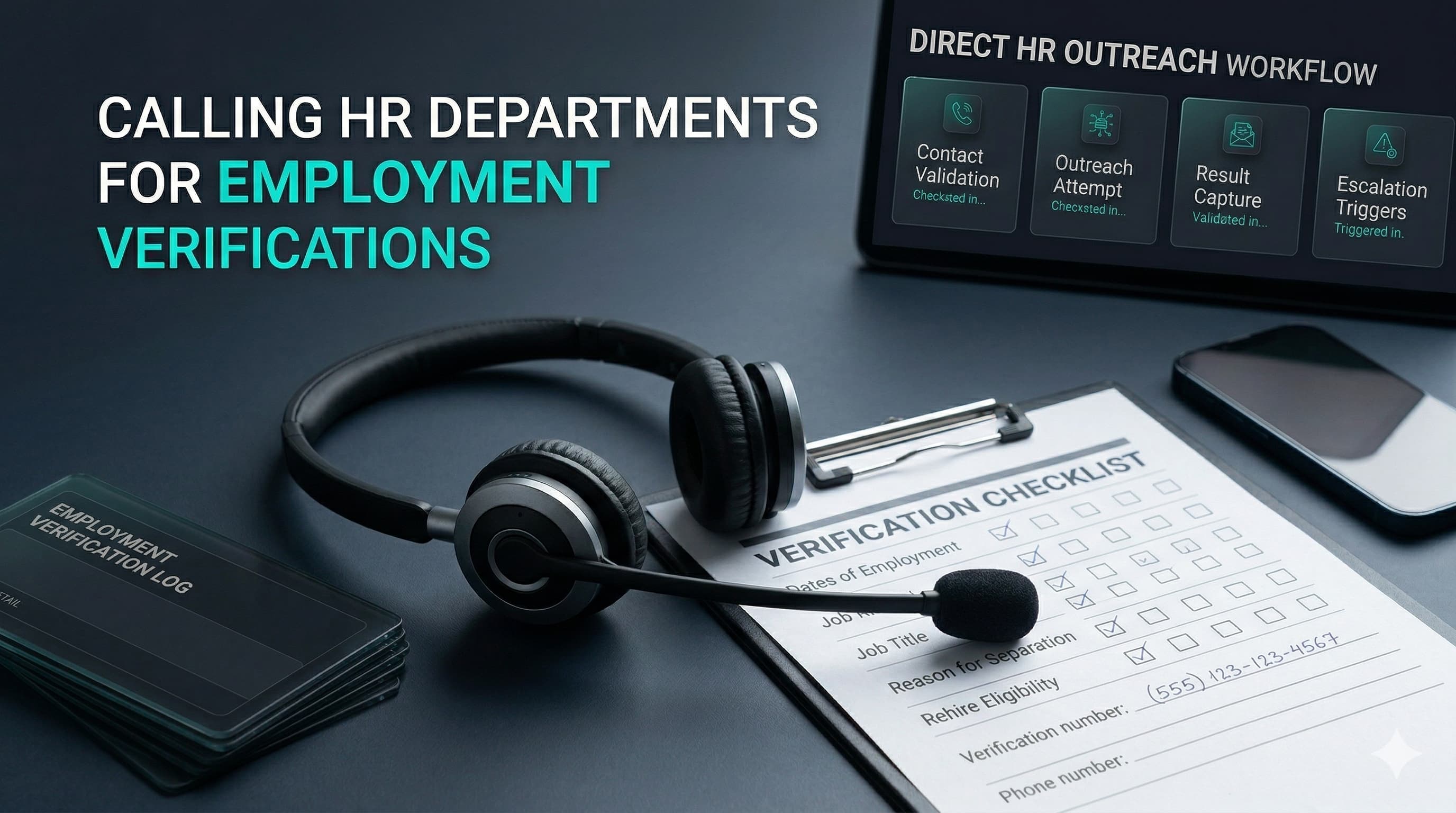
A repeatable phone verification workflow follows a consistent sequence: contact validation, outreach attempt, result capture, and escalation (if needed).
Contact validation is the first and most consequential step. Best-practice guidance from Clarifacts recommends independently validating the employer's phone number rather than relying on the number provided by the candidate or listed on a resume. Independent validation means cross-referencing the number against a business directory, the employer's official website, or a known corporate switchboard listing.
Outreach attempt follows. The verifier calls the validated number, identifies themselves and the purpose of the call, and asks a standardized set of verification questions. Standardized questions reduce variability across verifiers and make results easier to compare and review.
Result capture happens immediately after the call. The verifier records the outcome in a structured log, whether the call resulted in a completed verification, a partial response, a refusal, or no answer.
Escalation is triggered when the initial attempt fails. Escalation paths vary by organization but may include trying an alternate contact, leaving a voicemail with a callback number, sending a follow-up email or fax, or routing the case to a supervisor or specialized team.
Why Response Rates Vary So Much
Low response rates on direct HR outreach are common, and they are not always a sign that the process is broken. SHRM-sourced guidance indicates that employers are not always required to respond to employment verification requests. Even when they do respond, the information they are willing or permitted to share may be limited by internal policy or legal counsel advice.
Several employer-side factors drive response variability. Large employers with centralized HR service centers may route all verification requests through a third-party vendor, refusing to handle phone inquiries directly. Small employers may lack dedicated HR staff entirely, meaning calls go to a general voicemail or a receptionist who cannot authorize the release of employment information.
Privacy concerns, state-specific disclosure laws, and company policies that restrict responses to written requests with signed release forms all contribute to low phone response rates. A screening team that sees a 60% contact rate on direct outreach calls is not necessarily underperforming; it may simply be working a pool of employers whose policies limit phone-based disclosure.
What a Strong Call Attempt Strategy Looks Like
Effective HR outreach is built on validated contacts, consistent questions, and documented retry logic.
Validated phone numbers are the starting point. Using the candidate-provided number without verification introduces risk: the number may be outdated, may reach a personal contact rather than HR, or may connect to a different entity entirely. Independent validation through directory lookups, corporate website checks, or prior verified records reduces wasted attempts and improves contact rates.
Standardized verification questions keep the process repeatable and auditable. A typical question set covers dates of employment, job title held, and whether the employer can confirm the candidate's employment. Some employers will answer additional questions about compensation or separation reason, but the core set should remain consistent across all calls so that outcomes are comparable and defensible.
Documented retry logic means defining in advance how many attempts will be made, at what intervals, through which channels, and what triggers escalation to an alternate path. A common pattern is three phone attempts over three to five business days, with at least one attempt at a different time of day, followed by escalation if no response is received.
What Should Be Documented After Each Outreach Attempt
Every call attempt, whether successful or not, should produce a structured log entry. Documentation quality is a core differentiator between a defensible verification process and one that cannot withstand audit scrutiny.
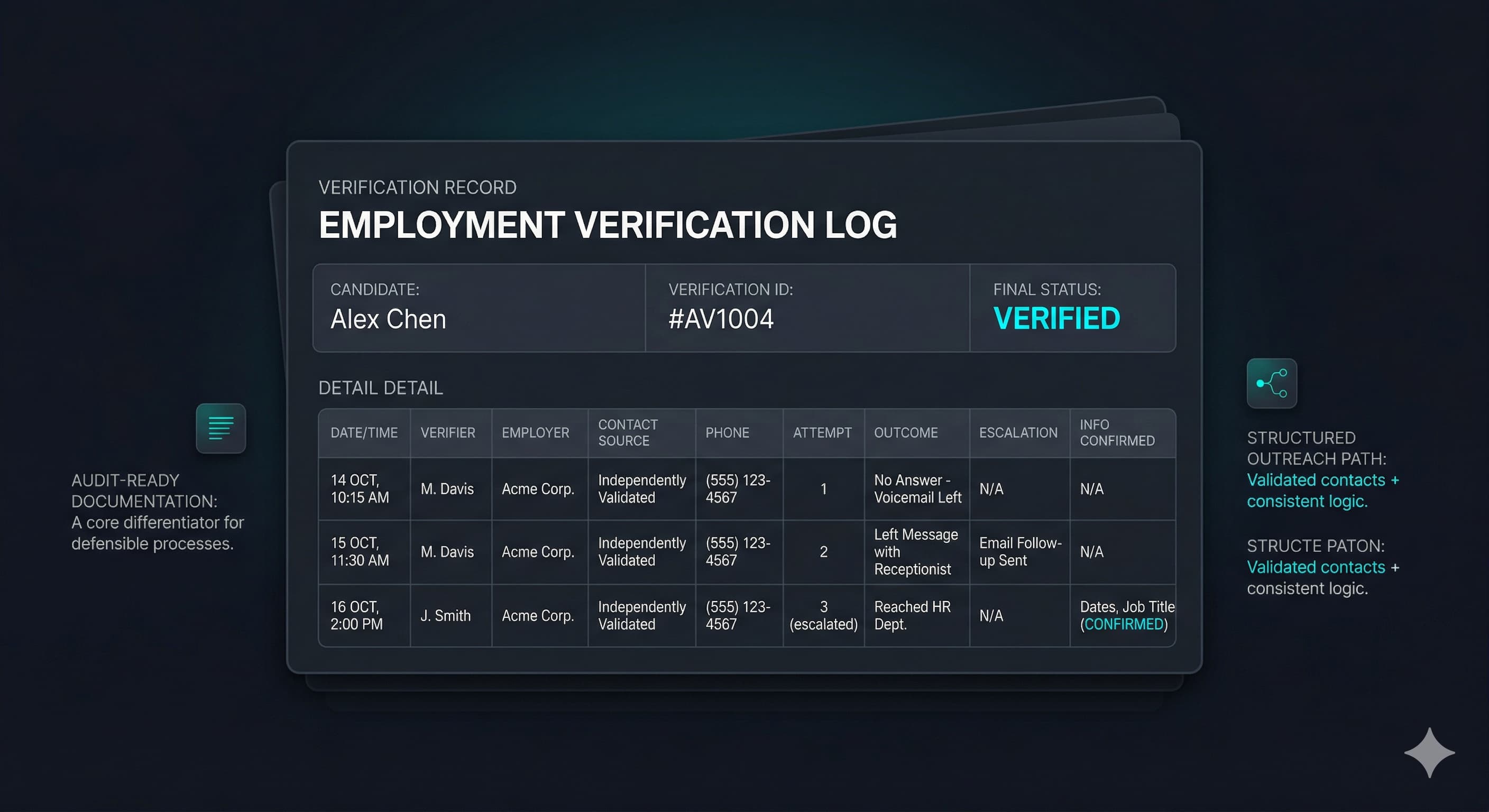
Based on industry documentation standards, a complete call log should capture:
- Request date: when the verification request was received
- Verifier name: the individual who placed the call
- Employer name: the company being contacted
- Contact source: where the phone number was obtained (directory, website, candidate-provided, prior record)
- Phone number used: the specific number dialed
- Date and time of each attempt: timestamps for every call, not just the final one
- Contact outcome: reached HR, left voicemail, no answer, wrong number, refused to verify
- Information confirmed: specific data points the employer provided
- Escalation step taken: alternate contact tried, written follow-up sent, supervisor review initiated
- Final disposition: verified, partially verified, unable to verify, refused to verify
Failed attempts and escalation steps are just as important to document as successful verifications. A log that only records completed verifications creates gaps that are difficult to explain during a client audit or regulatory review.
How Escalation Works When HR Is Unresponsive
Escalation is not optional in a mature verification workflow. When the primary HR contact does not respond after the defined number of attempts, a structured escalation path reduces the number of cases that end prematurely as "unable to verify."
Common escalation steps include trying an alternate phone number for the same employer, contacting a different department (such as payroll or the candidate's former manager, if policy allows), sending a written verification request by fax or email, and routing the case to a senior verifier or team lead for review.
The key principle is that escalation should follow a predefined sequence with documented triggers. A verifier should not decide independently when to stop calling; the workflow should define the conditions under which a case moves from active outreach to final disposition. "Unable to verify" is a legitimate outcome, but it should reflect a completed escalation path, not a premature stop.
What Affects Turnaround Time
Turnaround time on phone-based verifications is driven by three primary factors: contact quality, employer responsiveness, and escalation discipline.
Contact quality determines how quickly a verifier reaches the right person. If the phone number is validated and connects to a functioning HR line, the first attempt has a reasonable chance of success. If the number is outdated or routes to a general switchboard, multiple attempts may be needed just to identify the correct contact.
Employer responsiveness is largely outside the verifier's control. Some HR departments answer verification calls immediately; others have policies requiring a callback within 24 to 48 hours, and some will not respond to phone requests at all. A verification that depends on a callback from a slow-responding employer will take longer regardless of how quickly the initial call was placed.
Escalation discipline affects how much time is lost between a failed attempt and the next action. Teams that escalate quickly (same-day alternate attempts, next-day written follow-ups) shorten the overall cycle. Teams that wait several days between attempts or lack clear escalation triggers add avoidable delay.
Same-Day Verification: Realistic or Not?
Same-day completion is possible when the employer is reachable on the first attempt, willing to verify by phone, and able to confirm the requested information without internal review. These conditions align most often with small employers who have direct knowledge of the candidate's work history and no formal verification policy requiring written requests.
For larger employers, those with centralized HR service centers, or companies that route verifications through third-party vendors, same-day turnaround on a phone call is uncommon. The employer's internal process, not the verifier's speed, becomes the limiting factor.
Operations leaders should treat same-day verification as a best-case scenario rather than a standard expectation. Measuring performance against a same-day benchmark creates pressure that can lead to incomplete documentation, skipped escalation steps, or premature case closure. A more useful metric is the percentage of verifications completed within a defined SLA window (such as three to five business days) with full documentation and appropriate escalation.
Direct HR Outreach vs. Other Verification Methods
Phone verification is one of several methods available, and each has distinct strengths and limitations depending on the employer, the data needed, and the turnaround requirements.

Automated databases are the fastest and lowest-effort method, but they only work when the employer participates. Document review is fast but depends on the candidate providing valid records, and it may not satisfy all client or regulatory requirements. Written requests create a paper trail but tend to have the longest turnaround. Direct phone outreach fills the gap where none of these methods produce a result.
A well-designed verification workflow uses all four methods in a tiered sequence, starting with the fastest and most automated and falling back to phone outreach when needed.
Common Objections and Workflow Tradeoffs
"Phone verification is too expensive." Per-verification cost is higher for phone outreach than for automated checks, because it requires trained staff time and multiple attempts. The relevant comparison, though, is the cost of a completed phone verification versus the cost of an indefinitely open case or an unable-to-verify disposition that triggers additional review.
"Our team doesn't have the bandwidth." Staffing direct HR outreach requires either dedicated internal verifiers or an outsourced provider. The tradeoff is between control (internal) and scalability (outsourced). Either model works if the documentation and escalation standards are clearly defined and consistently followed.
"Employers won't tell us anything useful." Some employers do limit their responses to confirming dates of employment and job title, and a few will not respond at all. A strong workflow accounts for limited disclosure by defining what constitutes a sufficient verification and documenting exactly what the employer did and did not confirm. Partial verifications are still valuable when they are clearly documented.
"The documentation burden is too high." Structured call logs do require more effort per attempt than automated checks. That effort pays off during audits, client inquiries, and disputes. A verification that cannot be reconstructed from its documentation is operationally equivalent to one that never happened.
What Teams Should Look for in a Provider or Process
Whether building an internal phone verification capability or evaluating an outsourced provider, the evaluation criteria are the same.
Contact validation method. How does the team or provider identify and validate employer phone numbers? Relying solely on candidate-provided numbers is a red flag. Independent validation through directory cross-referencing or maintained employer contact databases indicates a more mature process.
Standardized outreach protocol. Is there a defined question set, a documented retry schedule, and a consistent escalation path? Providers or internal teams that cannot describe their standard operating procedure for a phone verification attempt are likely running an ad hoc process.
Audit-ready documentation. Can the provider produce a complete call log for every verification, including failed attempts and escalation steps? Ask to see a sample log with all fields populated. If the log only shows final outcomes without attempt-level detail, the documentation standard is insufficient.
Escalation workflow. What happens when the employer does not respond? How many attempts are made, through which channels, and on what timeline? What triggers the "unable to verify" disposition? A clear, documented escalation path is one of the strongest indicators of process maturity.
Status visibility. Can the operations team or client see real-time status for open verifications? Knowing whether a case is in first attempt, escalation, or pending employer callback allows better SLA management and reduces the volume of status inquiries.
Automation of outreach steps. Some providers now use AI agents to handle portions of the HR outreach workflow, including placing calls, sending emails and faxes, managing follow-up schedules, tracking case status, and generating structured documentation at each step. Superunit, for example, applies this approach to employment verification outreach. The operational advantage of agent-driven automation in this context is not simply labor reduction; it is the consistency of execution across every case. An automated agent follows the same retry logic, applies the same escalation triggers, and produces the same structured log entry whether it is handling ten verifications or ten thousand. That consistency is what makes the resulting records audit-ready and the escalation paths defensible.
Frequently Asked Questions
How many call attempts should be made before closing a verification as unable to verify?Three attempts over three to five business days is a common standard, with at least one attempt at a different time of day. The right number depends on the employer type and client requirements, but fewer than three attempts with no escalation is difficult to defend in an audit.
Can an employer refuse to verify employment?Yes. Employers are generally not required to respond to verification requests, and many limit their disclosures to dates of employment and job title. Documenting a refusal or non-response is itself a valid verification outcome when the attempt and escalation are properly logged.
What should a verifier do if the phone number on the candidate's application is wrong?The verifier should attempt to independently locate the employer's correct number through directory services, the employer's official website, or prior verified records. Calling an unvalidated number without cross-referencing introduces risk that the contact is not a legitimate employer representative.
Is phone verification more reliable than document review?Each method has different strengths. Phone verification confirms information directly with the employer, while document review depends on candidate-supplied records. Neither is universally more reliable; the best approach uses both methods as part of a tiered workflow where the strengths of one compensate for the limitations of the other.
Buyer Checklist: Evaluating an HR Outreach Process
- Employer phone numbers are independently validated before outreach
- Verification questions are standardized across all verifiers
- Retry logic is defined (number of attempts, timing, channel variation)
- Call logs capture every attempt, including failed ones
- Escalation triggers and paths are documented
- "Unable to verify" dispositions reflect a completed escalation sequence
- Real-time status visibility is available to the operations team or client
- Documentation meets audit and client reporting requirements
Conclusion
Direct HR outreach works best when it is treated as a structured workflow rather than a series of improvised phone calls. Response rates will always be partially determined by employer policy, disclosure limits, and whether the organization even accepts phone-based verification requests. No amount of calling overcomes an employer that will not pick up or is not permitted to share information.
What teams and providers can control is the quality of their contact validation, the consistency of their outreach protocol, the rigor of their documentation, and the discipline of their escalation paths. Those four elements determine whether a phone verification process produces audit-ready results or generates a backlog of poorly documented, prematurely closed cases. Evaluating a verification provider or an internal process comes down to whether those four disciplines are defined, followed, and visible, regardless of whether the work is performed by human verifiers, AI agents, or a combination of both.
Ready to get started?
Major CRAs trust us to handle the verifications no one enjoys — faster, cheaper, and fully documented. See how!