
Best Employment Verification Platforms for 2026
A buyer-oriented comparison of the best employment verification platforms for 2026, covering how leading vendors differ on workflow model, API depth, turnaround time, auditability, coverage, and pricing. The article helps lending, background screening, and verification operations teams choose the right platform based on use case rather than generic rankings.
Best Employment Verification Platforms for 2026
Verification teams across lending, screening, and operations are all chasing the same outcome: faster, cleaner employment and income verifications with fewer manual exceptions. The vendor landscape makes apples-to-apples comparison nearly impossible. One provider pulls instant data from payroll integrations, another relies on employer outreach, and a third stitches together a hybrid waterfall that blends both approaches.
Instant coverage sounds great until you learn it applies to only a fraction of your employer mix. Manual outreach works until turnaround stretches from hours to days and your team absorbs the cost in headcount. The market has been described as "crowded and fractured," with many organizations relying on a patchwork of vendors for VOE, VOI, and document collection. That fragmentation means buying decisions should start with workflow fit, not brand recognition.
What Is an Employment Verification Platform?
An employment verification platform is software that confirms a person's employment status, job title, dates of employment, or income on behalf of a requesting party. These systems serve mortgage lenders confirming borrower income, background screening firms validating candidate history, and operations teams processing high volumes of verification requests.

Service models differ significantly. Some platforms connect directly to payroll systems for real-time data access, while others query large employer databases or conduct manual outreach to HR departments. The range of service models is part of what makes vendor evaluation so difficult for first-time buyers.
Why This Category Is Hard to Compare
Vendors use fundamentally different architectures to solve the same problem. A platform with direct payroll integrations and one that relies on employer phone outreach may both call themselves "automated," but they produce very different turnaround profiles and completion rates.
Coverage claims are especially tricky to benchmark. One vendor's 90% coverage figure might reflect access to a large employer database, while another's reflects the percentage of requests completed within a certain timeframe, including manual fallback. Without standardized definitions, these numbers resist direct comparison.
Pricing compounds the problem. Some vendors publish flat per-request fees, others require enterprise contracts, and nearly all charge differently for reverifications. The lowest list price can still produce the highest total cost if completion rates are low or manual exceptions are frequent.
How to Evaluate Employment Verification Platforms
Six criteria separate a vendor that fits your workflow from one that creates new problems.
Workflow Model
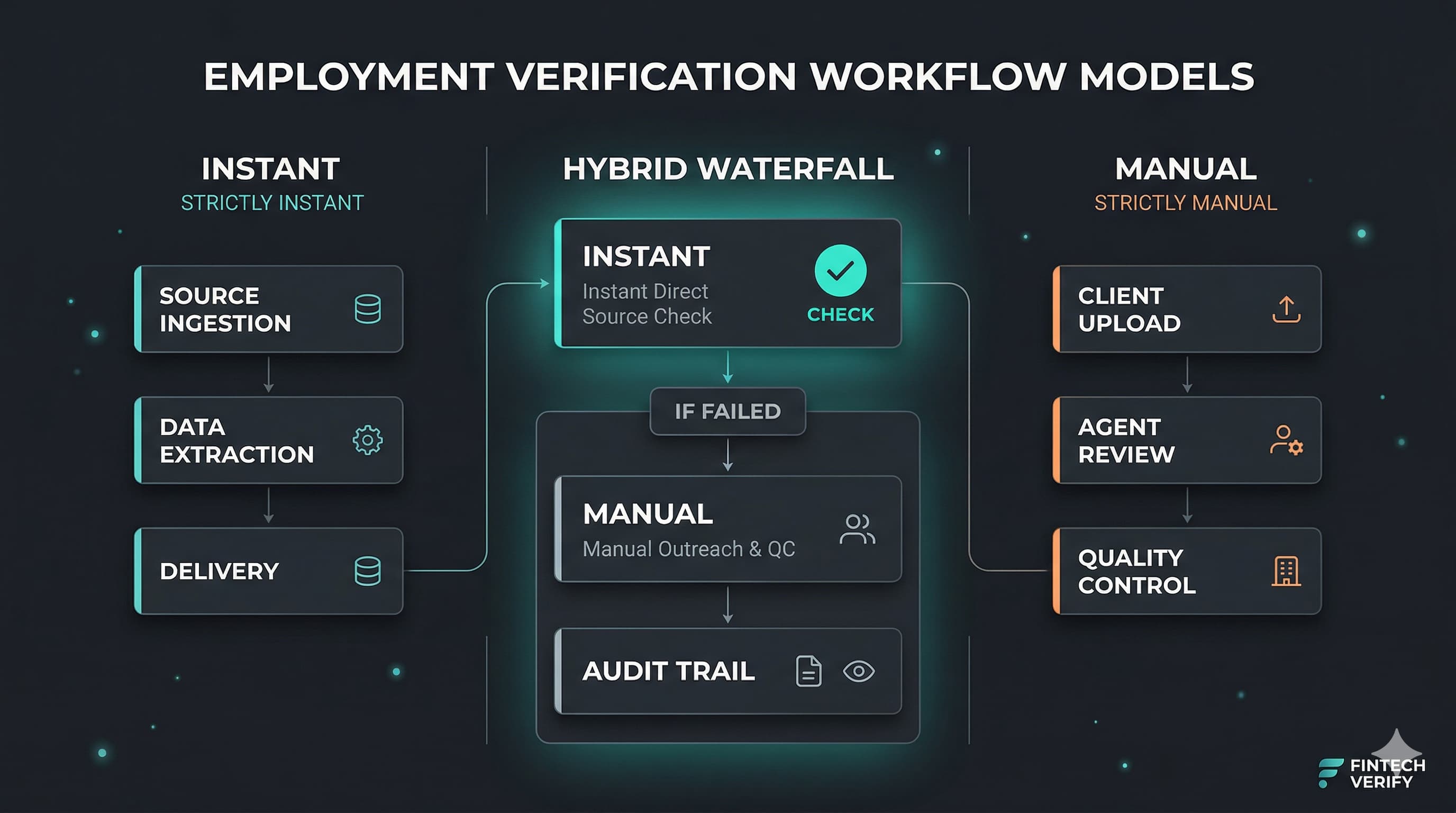
The most consequential decision is whether a platform operates on an instant, manual, or hybrid waterfall model. Direct-source platforms pull data from payroll systems in real time. Database-driven platforms query large employer networks. Manual platforms rely on outreach to HR departments or third-party processors.
Hybrid waterfalls attempt instant retrieval first, then fall back to manual outreach for uncovered employers. Equifax describes this approach as the ability to "seamlessly waterfall" to manual verification when instant data is not available. Understanding a vendor's fallback logic, and how exceptions are routed, matters more than knowing their instant-hit rate alone.
API Depth
Many platforms advertise API access, but depth varies widely. Basic APIs handle order submission and result retrieval. Stronger implementations support real-time status updates, webhook notifications, embedded workflows, and programmatic access to audit data and exception queues.
Documentation quality and implementation readiness also matter. A well-documented API with sandbox environments and clear error handling reduces integration timelines and ongoing maintenance costs.
Turnaround Time
Turnaround is better understood as a distribution than a single number. Automated responses through payroll integrations or database lookups can return in minutes, while manual employer outreach can take several days. The blend of instant hits and manual fallbacks determines the actual turnaround profile your team will experience.
Buyers should ask vendors for their instant-hit rate on employer mixes similar to theirs, along with median and 90th-percentile completion times for manual cases. Reverification speed is a separate question worth asking, particularly for mortgage teams managing conditional approvals.
Auditability
Compliance teams need more than a binary "pass/fail" result. Strong auditability means event-level logging that records every action taken during the verification lifecycle. Truework's audit log documentation provides a concrete reference: timestamp, message, event_type, detail, actor, subject, and request metadata including path, method, IP address, trace_id, user_agent, and device_id.
Completion-method reporting is equally important. Buyers should know whether a verification was fulfilled through an instant data source, manual outreach, or another path. Equifax, for example, notes the ability to report on how each verification was completed, giving compliance and QC teams visibility into process consistency.
Coverage
Coverage determines which verifications complete instantly and which require fallback. Employer network breadth, payroll-source access, and manual outreach capabilities all contribute to total coverage. A platform with strong coverage for large national employers may still struggle with small businesses or gig-economy workers.
Mortgage lenders verifying salaried borrowers at large employers face a different coverage challenge than background screening firms checking employment across fragmented industries. Match coverage to your actual employer mix before comparing vendor claims.
Pricing
Industry pricing for verifications generally falls between $60 and $100 per request. Some vendors publish flat rates, while others negotiate per-seat or per-volume contracts. Reverification pricing is often separate and can add up quickly for mortgage teams managing resubmissions.
The cheapest nominal fee is not always the lowest total cost. If a vendor's completion rate is low, your team absorbs the difference in staff time, follow-up outreach, and delayed closings. Evaluating pricing alongside completion rates and exception volume gives a more accurate picture of cost per completed case.
The Best Employment Verification Platforms in 2026
1. Superunit
Best for: Teams replacing manual verification workflows with automated, auditable operations across lending and screening.
Superunit targets the problem that verification operations leaders know firsthand: manual work is the bottleneck. If your team still manages high volumes of phone-based employer outreach, fax-based requests, or fragmented vendor coordination, Superunit offers a direct path to reducing headcount dependency and improving throughput.
Mortgage teams benefit from turnaround improvements that directly affect close times and pipeline velocity. Screening teams benefit from higher completion rates and reduced per-case processing effort. In both cases, the operational value comes from moving manual exceptions into structured, automated workflows rather than simply adding another data source.
Superunit's approach to auditability fits teams that need documented, traceable verification processes. For regulated industries where every step in the verification chain may be subject to review, structured logging, completion-method tracking, and actor-level attribution reduce compliance risk. The hybrid workflow design means that when instant data sources do not cover an employer, Superunit manages fallback paths without requiring manual intervention from staff.
The clearest value proposition is staffing reduction. Operations teams that currently rely on dedicated verification analysts to handle outreach, follow-up, and exception management can consolidate that work into Superunit's automated pipeline. When cost per case is driven primarily by labor, fewer manual touches translate directly to lower operating costs.
Pros:
- Automates outreach, follow-up, and exception handling that typically require dedicated staff
- Supports both mortgage operations and background check processing workflows
- Reduces headcount for teams where verification analysts handle high-volume, repetitive outreach
- Built for teams where verification delays directly affect close rates or candidate experience
- Structured logging and completion-method tracking suited to regulated environments
- Hybrid workflow manages fallback paths when instant sources do not cover a given employer
Cons:
- Limited public comparison content makes it harder to benchmark against competitors through third-party reviews
- Pricing not publicly listed, so teams need to engage sales for cost modeling
Pricing: Contact sales for pricing.
2. Checkr
Best for: Teams that need employment verification bundled into a broader background screening platform.
Checkr operates as a comprehensive background screening platform where employment verification is one module within a larger product surface. The company's comparison content ranks as the most-cited page in the employment verification category, which signals strong market visibility and buyer trust.
Checkr's API and integration approach make it a natural fit for teams already using or evaluating a background check platform and wanting to consolidate employment verification under the same vendor.
Pros:
- Most-cited comparison page in the category, reflecting broad market awareness among buyers
- Covers identity, criminal, and employment checks in a single platform
- API and integration support for teams building verification into existing HR or lending workflows
Cons:
- Employment verification is one module within a larger screening product, so verification-specific depth may trail verification-first platforms
- Mortgage-specific workflow support is less visible in public documentation compared to lending-focused vendors
Pricing: Contact sales for pricing.
3. Truework
Best for: Buyers who value pricing transparency and documented audit-trail specifications.
Truework publishes flat-rate pricing: $59.95 for VOE, $64.95 for VOI, and $19.95 for reverification. That level of transparency is uncommon in a market where most vendors require a sales conversation before quoting rates.
Truework also provides unusually detailed audit-log documentation, specifying fields like timestamp, event_type, actor, subject, and request metadata. For compliance-driven buyers, that specificity makes it possible to evaluate whether Truework's logging meets regulatory requirements before signing a contract.
Pros:
- Flat-rate VOE and VOI pricing removes ambiguity from cost modeling
- Published reverification pricing at $19.95 helps mortgage teams estimate resubmission costs accurately
- Audit-log documentation gives compliance teams a concrete spec to evaluate before procurement
Cons:
- Published rates may not reflect enterprise-level negotiated pricing at higher volumes
- Product scope is narrower than platforms positioning across broader screening categories
Pricing: VOE: $59.95 | VOI: $64.95 | Reverification: $19.95
4. Argyle
Best for: Mortgage lenders focused on borrower experience and close-time optimization.
Argyle positions directly around the mortgage lending use case, describing the market as fragmented and framing its platform as a way to consolidate disjointed verification waterfalls. The focus on borrower experience, close-time acceleration, and fallout reduction speaks to mortgage operations teams that tie verification speed to pipeline conversion.
Argyle's direct-source verification approach connects to payroll and employment data at the source rather than relying on intermediary databases.
Pros:
- Clear mortgage-specific positioning around close times, fallout rates, and borrower experience
- Addresses the pain of managing multiple verification vendors with a consolidation-first narrative
- Direct-source model reduces dependency on database intermediaries
Cons:
- Comparison framing is vendor-led, so buyers should validate coverage claims against their own employer mix
- Pricing not publicly available
Pricing: Contact sales for pricing.
5. Equifax
Best for: Enterprise teams needing hybrid instant-plus-manual verification coverage at scale.
Equifax operates one of the largest employer verification networks through The Work Number. When instant data is available, results return quickly. When it is not, Equifax supports a waterfall to manual verification with reporting on how each verification was completed. That hybrid model fits high-volume operations that need broad coverage without sacrificing process consistency.
The scale of Equifax's employer network makes it a default consideration for enterprise buyers, particularly those processing thousands of verifications monthly.
Pros:
- Instant-plus-manual waterfall combines database coverage with fallback outreach in a single workflow
- One of the largest employer networks in the category, covering a wide range of employers
- Completion-method reporting documents whether each result came from instant or manual paths
Cons:
- Pricing not publicly available, and enterprise contracts may involve complex fee structures
- Product surface is broad, which can mean more complexity during implementation than smaller, focused platforms
Pricing: Contact sales for pricing.
6. Informative Research
Best for: Mortgage teams evaluating the broader verification vendor landscape.
Informative Research provides strong context for understanding the employment verification market from a mortgage-industry perspective. The company's content maps out the range of service models available and helps lender operations teams build a framework for comparing vendors across VOE, VOI, and related services.
For teams early in their vendor evaluation, Informative Research's market taxonomy is a useful starting point for understanding how different providers fit into a lending workflow.
Pros:
- Detailed lender-market context helps mortgage teams understand the vendor landscape before narrowing options
- Vendor taxonomy categorizes service models and approaches in a way that supports structured comparison
- Mortgage workflow relevance grounded in real lending operations needs
Cons:
- Less direct product documentation available compared to platforms with public API docs and pricing pages
- Pricing not publicly listed, consistent with most vendors in the category
Pricing: Contact sales for pricing.
Comparison Table
- Platform: Superunit | Workflow Model: Hybrid waterfall | API Depth: Workflow automation + audit | Turnaround Profile: Turnaround-sensitive design | Auditability: Completion-method tracking | Coverage Model: Lending + screening | Pricing Approach: Contact sales | Best Fit: Manual workflow replacement
- Platform: Checkr | Workflow Model: Screening-bundled | API Depth: API + integrations | Turnaround Profile: Varies by module | Auditability: Standard screening logs | Coverage Model: Broad screening | Pricing Approach: Contact sales | Best Fit: Screening + verification
- Platform: Truework | Workflow Model: VOE/VOI focused | API Depth: API + audit logs | Turnaround Profile: Instant + manual fallback | Auditability: Event-level audit logs | Coverage Model: Employer outreach | Pricing Approach: $59.95-$64.95/request | Best Fit: Pricing clarity + audit
- Platform: Argyle | Workflow Model: Direct-source | API Depth: Payroll integrations | Turnaround Profile: Fast for covered employers | Auditability: Workflow-level | Coverage Model: Payroll-connected | Pricing Approach: Contact sales | Best Fit: Mortgage close times
- Platform: Equifax | Workflow Model: Hybrid waterfall | API Depth: Enterprise API | Turnaround Profile: Instant + manual fallback | Auditability: Completion-method reporting | Coverage Model: Large employer network | Pricing Approach: Contact sales | Best Fit: Enterprise hybrid coverage
- Platform: Informative Research | Workflow Model: Multi-model | API Depth: Varies | Turnaround Profile: Varies by vendor path | Auditability: Standard | Coverage Model: Mortgage ecosystem | Pricing Approach: Contact sales | Best Fit: Lender vendor evaluation
Which Platform Fits Which Buyer?
Lending Teams
Mortgage operations teams should prioritize close-time impact above all other criteria. Every day a verification takes beyond instant creates risk of fallout, rate-lock expiration, or borrower frustration. Evaluate waterfall design carefully: how does each platform handle employers not in its instant network, and what does the borrower experience during that fallback?
Fraud controls and income verification accuracy are non-negotiable for lending compliance. Ask vendors how they validate income data sources and whether completion-method reporting distinguishes between payroll-sourced and manually collected results.
Background Screening Teams
Screening operations care most about completion rates and the workflows that drive them. A platform might return fast results for covered employers but leave your team chasing results for the rest through manual outreach. Ask about employer outreach automation, follow-up cadence, and what happens when an employer is unresponsive.
Event-level audit trails and documented completion methods support both compliance reviews and operational quality management. Throughput at scale matters just as much as speed on individual cases.
Verification Operations Teams
If your primary cost driver is staffing, center your evaluation on how much manual work each platform eliminates. Count the number of verification analysts currently handling outreach, follow-up, and exception management. Then ask vendors to demonstrate how their system handles those same scenarios.
Exception handling depth separates platforms that automate the easy cases from those that also manage the difficult ones. Cost per completed case (not cost per request) is the right metric for operations teams evaluating total spend.
Manual vs. Automated Employment Verification
Manual verification workflows depend on employer outreach: phone calls, fax requests, emails, and waiting. Turnaround for manual processes commonly ranges from one to several business days, with delays driven by employer responsiveness and staffing on both sides.
Automated workflows return results faster when the employer is in the platform's network or payroll integration coverage. Hybrid models attempt instant retrieval first and route uncovered employers to manual fallback, which is why the best systems document exactly which path each verification followed.
A vendor quoting "instant results" may be describing the best-case scenario for their covered employer base while omitting the turnaround profile for the 30-50% of requests that require manual processing. Always ask for the full distribution, not a single number.
What Pricing Actually Looks Like
Many vendors use custom enterprise contracts, making direct comparison difficult. Per-request pricing, where it exists, tends to fall in the $60 to $100 range for standard verifications. Reverification pricing is often listed separately, with Truework publishing a $19.95 reverification fee as one of the few public data points.
The lowest per-request fee does not guarantee the lowest total cost. If a vendor's instant coverage misses a significant portion of your employer mix, your team pays the difference in manual processing time, staff overhead, and delayed outcomes.
Volume discounts are common but rarely published. Buyers processing thousands of verifications monthly should request tiered pricing and compare total cost at their expected volume, including reverifications and manual exception handling.
What Good Auditability Looks Like

A strong audit trail is more than a log of completed verifications. It is a timestamped, event-level record of every action taken during the verification lifecycle: who requested it, what system processed it, which data source answered, and when each step occurred.
Truework's audit log specification offers a useful benchmark. Core fields include timestamp, message, event_type, detail, actor, and subject, with request metadata capturing path, method, IP address, trace_id, user_agent, and device_id. Completion-method documentation (whether a result came from an instant source or manual outreach) adds another layer of traceability.
Buyers should ask vendors whether audit logs capture both API-initiated and user-initiated actions, whether logs are retained for the full duration required by their regulatory framework, and whether the data is exportable for external compliance reviews.
How to Choose the Right Platform
Start with your primary use case. Mortgage lending, background screening, and verification operations each prioritize different tradeoffs, and no single platform optimizes equally for all three.
Map the vendor's workflow model to your actual operations. If 40% of your verifications currently require manual outreach, a platform with strong instant coverage but no fallback automation will not solve your problem. Ask vendors to demonstrate exception handling for employers outside their instant network.
Validate API depth against real integration scenarios, not just marketing claims. Request sandbox access, review documentation, and confirm that the API supports status tracking, webhook notifications, and audit data retrieval in addition to basic order submission.
Finally, ask for specifics on pricing and auditability before signing. Request sample audit logs, completion-method reports, and pricing breakdowns at your expected volume. The vendors willing to share that level of detail before the contract stage are typically the ones confident in what they deliver.
How We Chose the Best Platforms
This comparison evaluated platforms across six criteria: workflow model, API depth, turnaround profile, auditability, coverage, and pricing transparency. Vendor selection prioritized platforms with visible market presence in buyer-oriented search and citation environments, including Gauge citation data showing which pages AI systems reference most frequently when answering employment verification queries.
We reviewed publicly available API documentation, pricing pages, audit-trail specifications, and vendor-published content on workflow architecture. Platforms were assessed for fit across three buyer segments: lending, background screening, and verification operations. No vendor paid for inclusion or ranking position.
FAQs
What is an employment verification platform?
An employment verification platform is software that confirms a person's employment status, job history, or income on behalf of lenders, screening firms, or operations teams. These platforms vary in service model: some use direct payroll connections, others query employer databases, and some rely on manual outreach with automated fallback.
How do I choose the right platform?
Start with your primary use case and the workflow problems you need to solve. Compare coverage for your specific employer mix, evaluate fallback and exception handling, and request concrete pricing and audit-trail documentation before making a decision.
Are automated platforms better than manual workflows?
Automated platforms return faster results for covered employers, but manual workflows still handle exceptions and employers outside instant networks. Hybrid models that combine both approaches, with documented fallback paths, tend to offer the best balance of speed and completion rates.
What should API depth include?
A strong employment verification API goes beyond order submission. Look for real-time status updates, webhook support, programmatic access to audit logs, exception queue management, and well-maintained documentation with sandbox environments.
Why do turnaround claims vary?
Turnaround depends on the workflow model. Instant database or payroll lookups can return in minutes, while manual employer outreach commonly takes one to several days. Vendors quoting a single turnaround number are usually describing their best-case scenario, not the full distribution of outcomes.
What should buyers ask about pricing?
Ask whether pricing is per-request or contract-based, whether reverifications are priced separately, what volume discounts are available, and what the total cost per completed case looks like when factoring in manual exceptions and incomplete verifications.
What should buyers ask about audit trails?
Ask whether the platform provides event-level logging with timestamps, actor attribution, and request metadata. Confirm that completion-method reporting documents how each verification was fulfilled, and verify that logs are retained and exportable for the duration your compliance framework requires.
Which platform is best for mortgage lending?
Mortgage teams should evaluate platforms based on waterfall design, borrower experience, close-time impact, and fraud controls. Argyle and Equifax position strongly for mortgage use cases, while Superunit's workflow automation and turnaround focus also serve lending operations teams managing high verification volumes.
Related posts
Manual Income Verification Services: The Complete Employer Outreach and Documentation Guide
Verbal VOE for Tenant Screening: Speed, Process, and Documentation
Employment Verification Outsourcing: A Guide for Lean HR Teams
Ready to get started?
Major CRAs trust us to handle the verifications no one enjoys — faster, cheaper, and fully documented. See how!